Life is replete with misery
Death bathes in peace
Isin't love of life therefore
Like loving a dreaded disease.
Compared to sorrow, the joys of life
Are minuscule by far.
Yet we savor the insignificant delights
Etched in memory, standstill as the Northern Star
All this is an illusion
Everything that we see
It may please our senses
But the truth it can never be
Life after death!
Could Death deal me such a blow
It ends life - it must!!!
True peace, how else shall I know?
NOTE: Written when I was probably pretty depressed.. no idea when
Friday, March 25, 2011

Teachers
Throughout our lives one hand guides us
Irrespective of the boundaries which divide us
It carries a light brightening our way.
We may falter but it doesn't sway.
It helps us achieve success and fame
Be it in studies or in a game.
It helps us maintain our life
Amidst all difficulties and strife
If we follow it, we are sure to gain
Freedom from vices, greed and vain.
This hand is but, the teachings of one
Pure as rain and bright as the sun.
That person is no less than a preacher
But better known to us a a Teacher.
NOTE: Written in 1997 on the occasion of Teacher's day.
Irrespective of the boundaries which divide us
It carries a light brightening our way.
We may falter but it doesn't sway.
It helps us achieve success and fame
Be it in studies or in a game.
It helps us maintain our life
Amidst all difficulties and strife
If we follow it, we are sure to gain
Freedom from vices, greed and vain.
This hand is but, the teachings of one
Pure as rain and bright as the sun.
That person is no less than a preacher
But better known to us a a Teacher.
NOTE: Written in 1997 on the occasion of Teacher's day.
I want to be
I want to be a bird
But I am fearful of heights.
I want to be a tiger
But it gives me the frights.
I want to be a bee
But am afraid of the sting.
I want to be an ant
But am scared of the troubles it'll bring.
I want to be a doctor
But am afraid of the dead.
I want to be a porter
But it'll be a load on my head.
I want to be an engineer
But it is a lot of strain.
I want to be a scientist
But it needs a lot of brain.
I want to be the Sun
But it's too hot for me.
I want to be the wind
But it's too fast for me.
I want to be the ocean
But it's too deep for me.
I want to be the stars
But they are too far from me.
I want to be a man
Which I can
I want to be kind
And not left behind
I want to be gracious
But not over ambitious
I want to be free
But not go in a spree
I want to be nice
But not gripped by vice
I want to laugh
I want to sing
I want to do my own thing.
NOTE: Written in 1996.. some things dont change.
But I am fearful of heights.
I want to be a tiger
But it gives me the frights.
I want to be a bee
But am afraid of the sting.
I want to be an ant
But am scared of the troubles it'll bring.
I want to be a doctor
But am afraid of the dead.
I want to be a porter
But it'll be a load on my head.
I want to be an engineer
But it is a lot of strain.
I want to be a scientist
But it needs a lot of brain.
I want to be the Sun
But it's too hot for me.
I want to be the wind
But it's too fast for me.
I want to be the ocean
But it's too deep for me.
I want to be the stars
But they are too far from me.
I want to be a man
Which I can
I want to be kind
And not left behind
I want to be gracious
But not over ambitious
I want to be free
But not go in a spree
I want to be nice
But not gripped by vice
I want to laugh
I want to sing
I want to do my own thing.
NOTE: Written in 1996.. some things dont change.
Life to Me
Life to me is a gushing stream
Neither bliss nor a dream.
It flows on without rest
Our patience and perseverance it does test.
I cannot define what life is
But, I only this
That I must toil day and night
And try with all my might..
People die but no one cares
Even at a dead body no one stares
Even I will die: that I know
But before I die and go.
I will leave my mark on the mind of man
And then to forget me who can.
NOTE: Written by me sometime around when I was 15 years old
Neither bliss nor a dream.
It flows on without rest
Our patience and perseverance it does test.
I cannot define what life is
But, I only this
That I must toil day and night
And try with all my might..
People die but no one cares
Even at a dead body no one stares
Even I will die: that I know
But before I die and go.
I will leave my mark on the mind of man
And then to forget me who can.
NOTE: Written by me sometime around when I was 15 years old
Thursday, December 16, 2010
Things are not as they appear
This post is probably going to be more or less random as I have no idea what I am going to think of in the next few minutes. The general idea I would like to explore is some of the basic principles that hide beneath some of our day to day activities and thought processes.
1) Murphy's Law:
In its crudest formulation it states that "Anything that can go wrong, will go wrong". I find this to be one of the widely quoted adages and have come across this in the context of many things. This is inherently a pessimistic approach at heart but I have known many who have interpreted this positively to try and counter as many problems as they could think of. Being an optimist (most of the time :-)) here is how I look at it from an analytical point of view.
This "law" in itself is just an adage with no mathematical or theoretical backdrop. This means that there is a finite probability that this may not be valid and may in fact be wrong. Thus as stated by this law itself, if it can go wrong, it will. This is a contradiction in itself and leads me to believe that this in fact does not hold good.
2) Short and sweet:
I think that the growing popularity of T20 in cricket, Youtube and Facebook etc are all linked to the same phenomena namely dwindling attention spans. As modern life gets more and more complicated, we are being bombarded with information every instant and our brains are not capable of handling the volume. In fact, our brains do not even process most of the information that our senses normally send it. It acts on what it thinks is important and saves the rest to our subconscious mind. This is one of the reasons why people under hypnosis can recall vivid details about an encounter while their conscious minds cannot.
I think that the way the brain tries to handle this information overload is by time slicing (a scheduling method) where it allots a small time frame for processing an event before moving on to the next.
The result of this is that we are becoming incapable of sustained thought which is essential for creative thinking. This is going to become a challenge in the future and I already see it happening on the job. The focus in any training be it for toddlers or engineers seems to be in keeping them engaged which is a good thing but I dont think it gets at the root cause.
3) Codes of Conduct:
Shall I be kind or turn a blind eye? A question that springs to mind every time I see a beggar or some shady character peddling something. Actually, the question is bigger than that. Most of us are faced with situations where we have to decide whether we should take a chance and help someone out and risk being taken for a ride. The response is usually dependent on non quantitative data like how kind (gullible) the person is or some other emotional response. Interestingly, this social interaction was modeled using a computer game a long time ago and many different strategies came to the table.
The biggest surprise was that out of all the models the most successful strategy that emerged was the simplest and something that we have always heard of: "Tit for tat".
This strategy comprises of a few simple rules:
Thoughts welcome!
1) Murphy's Law:
In its crudest formulation it states that "Anything that can go wrong, will go wrong". I find this to be one of the widely quoted adages and have come across this in the context of many things. This is inherently a pessimistic approach at heart but I have known many who have interpreted this positively to try and counter as many problems as they could think of. Being an optimist (most of the time :-)) here is how I look at it from an analytical point of view.
This "law" in itself is just an adage with no mathematical or theoretical backdrop. This means that there is a finite probability that this may not be valid and may in fact be wrong. Thus as stated by this law itself, if it can go wrong, it will. This is a contradiction in itself and leads me to believe that this in fact does not hold good.
2) Short and sweet:
I think that the growing popularity of T20 in cricket, Youtube and Facebook etc are all linked to the same phenomena namely dwindling attention spans. As modern life gets more and more complicated, we are being bombarded with information every instant and our brains are not capable of handling the volume. In fact, our brains do not even process most of the information that our senses normally send it. It acts on what it thinks is important and saves the rest to our subconscious mind. This is one of the reasons why people under hypnosis can recall vivid details about an encounter while their conscious minds cannot.
I think that the way the brain tries to handle this information overload is by time slicing (a scheduling method) where it allots a small time frame for processing an event before moving on to the next.
The result of this is that we are becoming incapable of sustained thought which is essential for creative thinking. This is going to become a challenge in the future and I already see it happening on the job. The focus in any training be it for toddlers or engineers seems to be in keeping them engaged which is a good thing but I dont think it gets at the root cause.
3) Codes of Conduct:
Shall I be kind or turn a blind eye? A question that springs to mind every time I see a beggar or some shady character peddling something. Actually, the question is bigger than that. Most of us are faced with situations where we have to decide whether we should take a chance and help someone out and risk being taken for a ride. The response is usually dependent on non quantitative data like how kind (gullible) the person is or some other emotional response. Interestingly, this social interaction was modeled using a computer game a long time ago and many different strategies came to the table.
The biggest surprise was that out of all the models the most successful strategy that emerged was the simplest and something that we have always heard of: "Tit for tat".
This strategy comprises of a few simple rules:
- Make your first move nice and co operate
- Be in a position where it is possible to retaliate
- Forgive past transgressions
Thoughts welcome!
Sunday, October 31, 2010
Naughts and Crosses
Owing to a debate at home regarding the age old game of Naughts and Crosses I decided to do a statistical analysis of the game itself. My initial premise was that the person making the first move is at an advantage and the analysis seems to validate this. Admittedly, I just analyzed the first six moves as most games are decided by that time (truth is I got lazy after 6 rounds of iteration :-) )
Maths Alert:
If you are easily nauseated by mathematical models and concepts or are below 100 years of age then please stop reading here.
Since you have not stopped reading I sincerely pity you but anyways here are the mundane details
1) The first question to be answered of course is how many moves are possible in the game itself. Simple math tells us that the number of ways two symbols (X and O) can be arranged in 9 positions is given by 2^9 which is 512. As usual, simple maths is not sufficient as we have to take into account the rules of the game which says that the symbols "X" and "O" must be placed alternately thus invalidating many of the combinations calculated by the mentioned method. I looked at it from a different perspective and realized that the game would involve 5 "X"s and 4 "O" upon conclusion. Thus the number of ways in which 5 "X"s can be placed in 9 places is 9C5. This is 9!/(5!*4!) = 126. The remaining 4 positions can be filled by 4 "O"s in 1 way. Thus the total number of combinations possible is 126
2) Looking at the layout, it becomes apparent that there are 8 possible routes that spell victory (Figure 1). Thus the possibility that a "X" or "O" is placed on a path that may lead to victory is 8/126 = 0.06

Figure 1
3) Now the fun part :-).
For each possible moves there is a possibility that the placed symbol may lie on a number of "success" paths. Looking at the best case and worst case scenarios in each case we come up with the following:
For the first move by Mr "X" he can opt to put an "X" in positions that put the symbol on a path that is common to 4, 3 or 2 success paths. Taking the best case and worst case scenarios which look like Figure 2 we end up with probabilities of 0.24 (4*0.06) or 0.12 (2*0.06)

Figure 2
4) Now Mr "O" also has best case and worst case scenarios depending on what Mr "X" has done and we end up with the following scenarios (Figure 3)

Figure 3
The corresponding best case and worst case probabilities are therefore 0.18 and 0.06
5) Repeating this iteratively for 4 more moves we end up with the following scenarios (Figure 4)

Figure 4
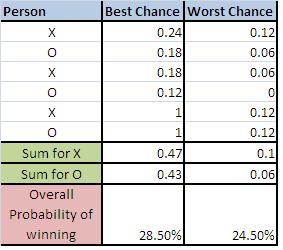
The following table presents the Best Case and Worst case probabilities for each move and then sums up the probabilities for Mr "X" and Mr "O". The average overall probability considering equal weightages for Best case and Worst case scenarios is then calculated.

6) My conclusions
a) The person beginning first has a 28.5% chance of winning
b) The person going second has a 24.5% chance of winning
c) Overall there seems to a 47% chance of a draw
NOTES: Please find below some of the answers to the questions that this blog article may prompt you to ask me.
1) Yes, I have a life
2) I do have a job
3) There was no point in doing this
4) You shouldnt bet money on this analysis
5) Oh Yeah?
6) Same to you.
:-)
Cheers
Sam
Maths Alert:
If you are easily nauseated by mathematical models and concepts or are below 100 years of age then please stop reading here.
Since you have not stopped reading I sincerely pity you but anyways here are the mundane details
1) The first question to be answered of course is how many moves are possible in the game itself. Simple math tells us that the number of ways two symbols (X and O) can be arranged in 9 positions is given by 2^9 which is 512. As usual, simple maths is not sufficient as we have to take into account the rules of the game which says that the symbols "X" and "O" must be placed alternately thus invalidating many of the combinations calculated by the mentioned method. I looked at it from a different perspective and realized that the game would involve 5 "X"s and 4 "O" upon conclusion. Thus the number of ways in which 5 "X"s can be placed in 9 places is 9C5. This is 9!/(5!*4!) = 126. The remaining 4 positions can be filled by 4 "O"s in 1 way. Thus the total number of combinations possible is 126
2) Looking at the layout, it becomes apparent that there are 8 possible routes that spell victory (Figure 1). Thus the possibility that a "X" or "O" is placed on a path that may lead to victory is 8/126 = 0.06

Figure 1
3) Now the fun part :-).
For each possible moves there is a possibility that the placed symbol may lie on a number of "success" paths. Looking at the best case and worst case scenarios in each case we come up with the following:
For the first move by Mr "X" he can opt to put an "X" in positions that put the symbol on a path that is common to 4, 3 or 2 success paths. Taking the best case and worst case scenarios which look like Figure 2 we end up with probabilities of 0.24 (4*0.06) or 0.12 (2*0.06)

Figure 2
4) Now Mr "O" also has best case and worst case scenarios depending on what Mr "X" has done and we end up with the following scenarios (Figure 3)

Figure 3
The corresponding best case and worst case probabilities are therefore 0.18 and 0.06
5) Repeating this iteratively for 4 more moves we end up with the following scenarios (Figure 4)

Figure 4
The following table presents the Best Case and Worst case probabilities for each move and then sums up the probabilities for Mr "X" and Mr "O". The average overall probability considering equal weightages for Best case and Worst case scenarios is then calculated.
6) My conclusions
a) The person beginning first has a 28.5% chance of winning
b) The person going second has a 24.5% chance of winning
c) Overall there seems to a 47% chance of a draw
NOTES: Please find below some of the answers to the questions that this blog article may prompt you to ask me.
1) Yes, I have a life
2) I do have a job
3) There was no point in doing this
4) You shouldnt bet money on this analysis
5) Oh Yeah?
6) Same to you.
:-)
Cheers
Sam
Sunday, October 3, 2010
Beware of Logic
I have recently realized that many of the morons I have encountered over the years are not to be blamed for their condition. Under normal circumstances, it seems that everyone has a preference to think logically (or at least try). So why is that, that an overwhelming majority still believe in God, Astrology, Birthstones and the like? The root cause of this seemingly contradictory behavior lies in a flawed sense of logic. Though most people would like to think logically, the very definition of logic seems to take on different colors for different people and as is obvious, most have no idea what logic really implies. I have tried to analyze some of the common fallacies that I have come across and I am pretty sure most of you would have encountered the same.
1) Burden of Proof – This tops the chart by a long shot and I have come across this in the context of practically every supernatural phenomenon you can think of ranging from God to gemstones. The premise is simple. The person holding the viewpoint is convinced that because I am not capable of proving that the thing being discussed does not exist, hence it must exist. To them this seems perfectly logical. Unfortunately, logic dictates that the “Burden of Proof” lies with the one holding the belief and thus unless someone can prove that God exists, logically it does not. There is no way to prove that something does not exist.
Invoking reductio ad absurdum, let’s say I say that I believe that there exists a three headed lion that can breathe under water and talk like a human. Can anyone prove to me that it does not exist and hence I conclude that it must exist? Seems silly now doesn’t it?
2) Appeal to tradition/popularity – This is the lazy mans definition of logic. The central premise of this is that if something has been going on for generations or is endorsed by a majority of the people then that is a necessary and sufficient cause to prove its validity. The fallacy here is that the age of a belief or the number of people following it has no correlation to its validity. Traditionally, we had believed in Earth being the center of the solar system, the earth being flat, speeds beyond 25 mph are lethal, diseases being caused by witches and demons and now we all know how these went. There is perhaps a link to this kind of logical fallacy and the natural tendency of people to shy away from anything new.
3) “Post hoc, ergo propter hoc” and Relativist Fallacy - Post hoc, ergo propter hoc literally means ”After this, therefore because of this” and this seems to be the root cause of many superstitions. This logical fallacy is ascribing cause and effect simply on the basis of when events occurred. Someone may have bought a lucky charm and after a month something happened and hence the conclusion is reached that the charm must have something to do with it. This is similar to someone jumping in India and an earthquake in California that happens a month later being described as cause and effect. Relativist fallacy is typical escapism. The idea here is that the truth is subjective. This typically comes up when a person has to admit that he/she is logically incorrect but then goes on to say that he/she has personally experienced something or “believes” that something is correct. This stems from an individual’s reluctance to give up long held beliefs and they find it easier to find escapism by making truth subjective and they conclude that they somehow fall outside the purview of what is logical.
I find this to be rather interesting, because it shows that most people would like to justify their beliefs and that is a good sign. The only problem being then is that what they deem as logic is unfortunately not so. A classic example is perhaps the belief in Astrology. Ancient civilizations found out that they could observe the motion of stars across the sky to predict seasons and that was invaluable to them for deciding when to plant crops and when to harvest etc. Thus to them it was also “logical” to assume that if the stars could influence the seasons then they were also bound to have some effect on human lives and destiny. Thus the belief in astrology started.
The fallacy here is obvious. The seasonal changes are actually caused by the rotation/revolution around the sun and the position of the stars have no role to play. Let me assure you that meteorologists can predict the monsoons accurately about a week in advance and they are not star gazing. So, we have stopped relying on the stars for predicting seasons but we still hold on to the secondary belief of them influencing us? Hilarious to say the least. Maybe logic should be made a compulsory subject in schools. The least we owe to the future generations is to give them the right to decide for themselves what is fact and what is fallacy.
1) Burden of Proof – This tops the chart by a long shot and I have come across this in the context of practically every supernatural phenomenon you can think of ranging from God to gemstones. The premise is simple. The person holding the viewpoint is convinced that because I am not capable of proving that the thing being discussed does not exist, hence it must exist. To them this seems perfectly logical. Unfortunately, logic dictates that the “Burden of Proof” lies with the one holding the belief and thus unless someone can prove that God exists, logically it does not. There is no way to prove that something does not exist.
Invoking reductio ad absurdum, let’s say I say that I believe that there exists a three headed lion that can breathe under water and talk like a human. Can anyone prove to me that it does not exist and hence I conclude that it must exist? Seems silly now doesn’t it?
2) Appeal to tradition/popularity – This is the lazy mans definition of logic. The central premise of this is that if something has been going on for generations or is endorsed by a majority of the people then that is a necessary and sufficient cause to prove its validity. The fallacy here is that the age of a belief or the number of people following it has no correlation to its validity. Traditionally, we had believed in Earth being the center of the solar system, the earth being flat, speeds beyond 25 mph are lethal, diseases being caused by witches and demons and now we all know how these went. There is perhaps a link to this kind of logical fallacy and the natural tendency of people to shy away from anything new.
3) “Post hoc, ergo propter hoc” and Relativist Fallacy - Post hoc, ergo propter hoc literally means ”After this, therefore because of this” and this seems to be the root cause of many superstitions. This logical fallacy is ascribing cause and effect simply on the basis of when events occurred. Someone may have bought a lucky charm and after a month something happened and hence the conclusion is reached that the charm must have something to do with it. This is similar to someone jumping in India and an earthquake in California that happens a month later being described as cause and effect. Relativist fallacy is typical escapism. The idea here is that the truth is subjective. This typically comes up when a person has to admit that he/she is logically incorrect but then goes on to say that he/she has personally experienced something or “believes” that something is correct. This stems from an individual’s reluctance to give up long held beliefs and they find it easier to find escapism by making truth subjective and they conclude that they somehow fall outside the purview of what is logical.
I find this to be rather interesting, because it shows that most people would like to justify their beliefs and that is a good sign. The only problem being then is that what they deem as logic is unfortunately not so. A classic example is perhaps the belief in Astrology. Ancient civilizations found out that they could observe the motion of stars across the sky to predict seasons and that was invaluable to them for deciding when to plant crops and when to harvest etc. Thus to them it was also “logical” to assume that if the stars could influence the seasons then they were also bound to have some effect on human lives and destiny. Thus the belief in astrology started.
The fallacy here is obvious. The seasonal changes are actually caused by the rotation/revolution around the sun and the position of the stars have no role to play. Let me assure you that meteorologists can predict the monsoons accurately about a week in advance and they are not star gazing. So, we have stopped relying on the stars for predicting seasons but we still hold on to the secondary belief of them influencing us? Hilarious to say the least. Maybe logic should be made a compulsory subject in schools. The least we owe to the future generations is to give them the right to decide for themselves what is fact and what is fallacy.
Subscribe to:
Posts (Atom)